
Beep. Beep. Beep.
Snooze.
Five minutes later: Beep. Beep— click. A small, groggy victory.
It’s 7:45, which means I have fifteen minutes to get ready for school. I throw on my Tuesday best, rush downstairs, and grab a slice of freshly buttered toast hugging my mom with my free hand as I head out the door. There are three minutes until the bell rings for my 8 a.m. sixth-grade algebra class. It’s a five-minute walk, but I calculate that if I sprint I can make it in two. With Nikes on my feet, toast in one hand, and a Lunchables in the other, I bolt down the street. Passing David’s house, I notice the empty driveway - his parents already dropped him off on the way to work. A few yards ahead is Kevin, equally determined. I shout for him to slow down, but his tiger mom shoots me a look from the driveway, as if a tardy would jeopardize both our futures. I shrug, pick up the pace, and with seconds to spare, Kevin and I slide into line just as the bell rings. Another buzzer beater. Another small victory.
At the time, this felt like life: always slightly late, always moving quickly, always assuming someone had built a system that would catch you if you stumbled. As I’ve grown older, I’ve become increasingly aware of how fortunate I was to be raised in Fremont, California. A city where grocery stores were never more than a mile apart, boba shops filled every plaza, and ambition hung thick in the air quietly absorbed by the next generation. Crime was low. Schools were strong. Opportunity felt assumed. But like any city, it also had parts you learned not to look at for too long.
Take a shortcut down a side street and the picture changes: encampments tucked into hidden alleys, RVs lining low-traffic commercial roads, or tents beneath highway overpasses. I drove faster when I encountered these places and always avoided eye contact with the man holding the sign at the intersection not in hostility but in unfamiliarity. I didn’t know the rules of engagement or how to enter those spaces without feeling intrusive or exposed. Within a city defined by abundance, progress, and opportunity, there were also clear signs of lack. And for most of my life I passed them by.
On a Tuesday night in 2020, I joined my friend K to go to an encampment which he’d been visiting every week for over a year. His involvement started with curiosity and Nature Valley granola bars. He drove through one day, interested in what was happening, offered the crumbled snack, stayed to talk, and eventually developed friendships. That same curiosity shaped our plan that night. We loaded his car (this time with baked goods and snacks grouped deliberately) and headed toward C Street. On the drive over, K explained the dynamics of the street and boy was it complex. There were conflicts, entanglements, alliances, drama, risk, and harm. What did I expect when lives live so publicly and without margin? I continued to listen, nodding, trying to picture what we were walking into. We parked at a bend in the road and stepped out of the car.
C Street was quiet. No real traffic. No reason to be there unless you worked nearby or needed a way through town. I remembered driving the street on the way to the gym during rush hour. Looking down the street, the contrast was immediate. On the left: neat commercial buildings, parked cars, trimmed hedges, clean sidewalks. On the right: worn-down clearly lived in RVs, tents, piles of belongings, trash bins overflowing, the smell lingering in the air. It was Fremont as I knew it, pressed directly against a world I had barely acknowledged. I felt embarrassed - not just that this existed so close to home, but that it had taken this long for me to notice.
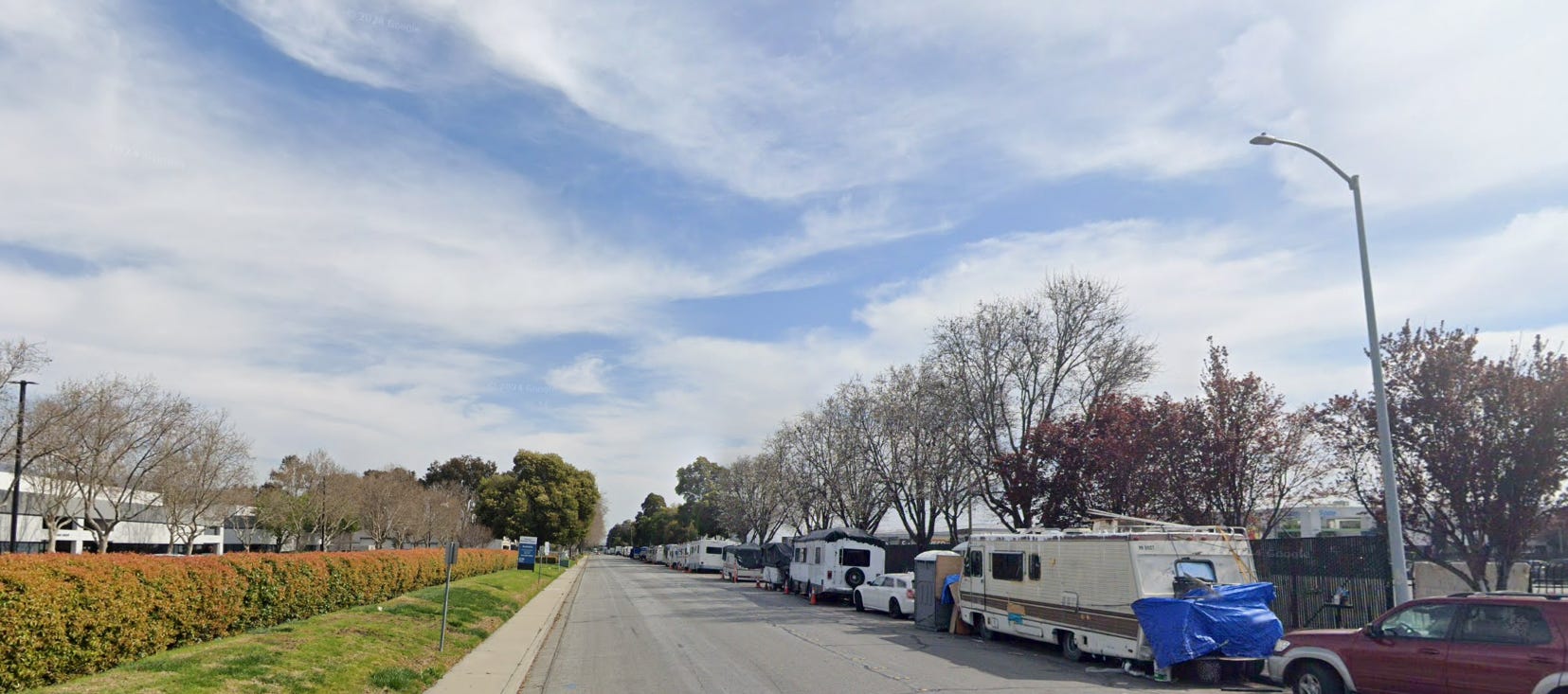
We crossed to the right side of the street and stopped at the first RV. K knocked. The door opened almost immediately. A woman named S greeted us, followed closely by a massive pit bull that ran straight toward me. I had never had a dog charge me like that before.
“K!” she shouted, breaking into a smile as she hugged him.
I stood off to the side while K introduced me and S asked a few polite questions. I answered quietly. Mostly I watched the ease between them. At one point, she shared something heavy. K listened and didn’t interrupt. Unsure what to do, I stepped back and crouched to pet the dog. I noticed a large tumor protruding from its side. K later told me it had been growing for months and there wasn’t money to remove it. Still, the dog leaned into my hand, tail wagging, content in a way that felt incongruous with what it carried. K prayed for S. We hugged and said goodbye.
At the next RV, no one answered. K knocked once. Then again. Then called out. Nothing. He jogged back to the car, returned with a bag of Chips Ahoy, handed them to me, and told me to place it on the curb in front of the RV door.
“These are their favorite.”
On our way to another RV, a man biked past us slowly, watching as if we weren’t supposed to be there. I felt my shoulders tighten. K waved casually and asked if he wanted any extra groceries.
“What do you got?” the man said.
We walked back to the trunk. K lifted it open, revealing the abundance inside. The man took a few things, nodded in gratitude, and rode off. Later, K told me he barely knew him and that he’d felt unwelcome too. It was their first interaction since K first visited over a year ago. K smiled at the openness of it. My shoulders finally relaxed.
The rest of the night unfolded in a quiet rhythm. Some people were home. Some weren’t. Conversations happened where they could. When they did they sounded familiar: updates from the week, frustrations, small delights. K shared about his job, his family. Advice passed back and forth without ceremony. I noticed how little he tried to fix anything.
I drove home from C street feeling unsettled and I couldn’t yet name why. Nothing dramatic happened and interactions mostly felt normal. No clear lesson revealed itself but I knew something in me had shifted.
Consistent as he is, K went back the following Tuesday. And the Tuesday after that. Eventually so did I. At first, I came alongside him. Then one week I went alone. I was nervous the whole drive. Of course people missed him and asked where he was. Over time, relationships formed slowly and unevenly. Some weeks felt meaningful. Others felt awkward. Sometimes nothing happened at all. I began to notice changes not neatly and not all at once. Someone talked about cutting back. Some spoke a little differently about themselves. Some asked for prayer when they never had before. What I did know was my Tuesday nights no longer felt optional. For months I returned. Somewhere along the way, I realized I was no longer just observing renewal but standing inside it. I was changing too - walking alongside others as we discovered dignity, love, purpose, and opportunity together.
There are places we pass every day without seeing. Streets we use as shortcuts. Lives lived inches from ours that remain unseen because noticing them would ask something of us. Growing up in Fremont, I learned how to move quickly—to make the most of opportunity, to stay on pace, to climb. I assumed the goal was to keep advancing, trusting that the system would reward effort and catch you if you slipped.
C Street undid that. There were the occasional buzzer-beater victories, but no ladder. No clean progress. Just people, week after week, living without margin. I went there thinking I would witness change - or be the one to drive it. And while change did happen, I learned that all the important work happened outside of my control. Progress is slow. Outcomes are unclear. And the only measure that matters is whether you show up and make yourself available.